Buy It For Life Safety Razors Ranked by Metal
Buy it for life safety razors are built from brass, stainless steel, or CNC aluminum, not chrome-plated Zamak that snaps at the thread collar within years.

Most reviews rank double-edge razors by closeness, comfort, and beginner friendliness. That metric completely misses the point if you want a tool that survives decades. A perfectly close shave means nothing if the handle snaps in half. When evaluating buy it for life safety razors, the deciding factor is not the brand, the head geometry, or the aggressive blade gap. The only thing that genuinely matters is the metal hidden underneath the chrome plating.
Stay in the loop.
Get the latest posts and exclusive content delivered to your inbox.
Join 25 readers. No spam. Unsubscribe in one click, anytime.
Most premium-looking handles are cast from Zamak, a brittle zinc alloy that fails at the thread collar over a few years of daily use. The metal beneath the chrome determines whether a razor lasts decades or only years. Pair that with the steep economic gap between double-edge blades and cartridges, and a grooming preference becomes a measurable lifetime cost decision.
The Zamak Problem and the Thread Collar Snap
Zamak is a family of zinc alloys heavily used in consumer goods. Zamak alloys are cheap, easy to cast, and hold fine details beautifully, which explains why the vast majority of classic-looking safety razors rely on them. They look and feel premium straight out of the box.
The problem runs deeper than simple brittleness. Zinc alloys have two specific metallurgical weaknesses that make them unsuitable for a tool meant to last decades: low ductility and high notch sensitivity. Low ductility means the metal cannot absorb deformation energy, so stress that would merely bend brass causes zinc to fracture instead. Notch sensitivity means any sharp internal corner, such as the base of a threaded post, concentrates stress dramatically at that single point.
The thread collar is the narrowest cross-section on the entire razor, where the handle screws into the head. Every time you tighten the handle, all the torque loads onto this tiny junction. The failure does not happen instantly. It progresses through a predictable sequence: repeated stress creates micro-cracks at the collar's base, moisture seeps through invisible fissures in the chrome plating, and the zinc slowly oxidizes from the inside. One morning you tighten the handle a little too firmly, or you knock it against the sink, and the collar snaps cleanly off inside the razor head. This failure mode is terminal and impossible to repair at home without specialized welding equipment. Experienced wet shavers document this pattern repeatedly. Discussions about Zamak thread collar breakage frequently describe how a pristine razor suddenly separates at the neck after years of trouble-free use.
Chrome plating is cosmetic, not structural. A shiny chrome finish prevents surface rust but does nothing to reinforce the brittle zinc underneath. Chrome-on-zinc follows the same failure pattern documented in chrome bathroom fixtures: the plating micro-cracks from daily handling, water reaches the raw zinc alloy, and internal corrosion accelerates. The plating fails first, then the metal follows.
Beloved, highly recommended razors fall directly into this trap. The classic Merkur 34C and the Mühle R89 are chrome-plated zinc alloys. They shave beautifully and have decades of loyal followers, but they are categorically not lifetime tools.
The Three Metals That Survive Decades
If you want a tool you will still hold thirty years from now, look entirely past zinc alloy. Only three handle materials reliably survive decades of daily wet shaving, and each one feels distinctly different in the hand.
- Cast Brass. Pick up a brass razor and the first thing you notice is the heft. The metal sits warm in your palm, dense and settled, and it absorbs the torque of tightening without ringing or pinging the way zinc does. Over years of daily use the surface develops a patina that darkens and deepens, so the razor looks more lived-in rather than more worn out. Brass is ductile, which means it bends under stress instead of shattering. A thread collar machined into solid brass will deform slightly if you over-torque it, then keep functioning for another decade. That mechanical forgiveness is something Zamak physically cannot replicate.
- 316 Stainless Steel. Stainless steel is the metal you buy when you never want to think about replacement again. Screw the handle into a CNC-machined stainless head and the threads mate with a cold, precise click, no wobble, no play, no gradual loosening over months of use. 316 stainless steel resists the chlorides in tap water and shaving soap that pit cheaper alloys, and because the part is machined from solid billet rather than cast, there is no hidden interior to harbor structural flaws. The density is reassuring rather than cumbersome. The tool feels engineered to outlast the person who bought it.
- CNC Aluminum. Aluminum flips the weight equation. A machined aluminum handle surprises you the first time you pick it up, because it weighs far less than you expected. That lightness changes the shaving stroke. Instead of pressing the blade into your skin and letting gravity drive the cut, you guide the razor along your face, which gives some shavers better control and less irritation than a heavy handle allows. Properly anodized aluminum forms a surface layer harder than the raw metal beneath it, so the protection is integral to the part rather than a coating that can chip or flake. Nimble can outperform heavy when precision matters more than momentum.
The three metals differ in how they machine, how much they weigh, and how they respond to sustained moisture. A handle material comparison lays out those differences side by side so you can judge them before buying.
Blade Economics Over a Decade of Shaving
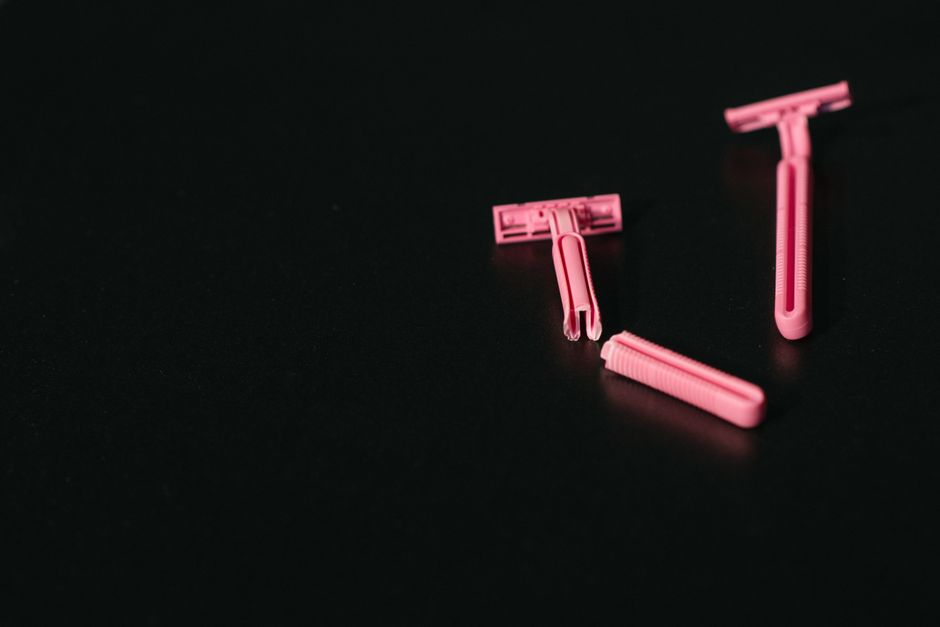
The savings from switching to double-edge blades are real, but they carry a catch that every standard cost calculator misses. Those savings only materialize if the handle survives the full decade. Buy a $35 chrome-plated Zamak razor that snaps at the thread collar in year four, and you are shopping for a replacement, eroding the gap you thought you had. A stainless steel or brass razor is the only purchase that captures every year of the savings, because the metal outlasts the math.
With that condition established, the numbers still favor DE blades decisively. Assume one fresh blade per week, roughly 50 blades per year.
- Cartridges. A premium cartridge costs between $2.00 and $4.00. At $3.00 per cartridge, you spend $150 a year and $1,500 over a decade. Analyses of long-term cartridge razor costs corroborate this range.
- DE Blades. High-quality bulk DE razor blades cost between $0.10 and $0.30 each. At $0.20 per blade, you spend $10 a year and $100 over the same decade.
The gap is roughly $1,400 per decade, but only if the handle is still in your hand in year ten. Two replacement handles add $70 to your total over the decade, barely denting the $1,400 gap. But the point is structural: the buy-it-for-life promise breaks if the metal fails mid-decade. This is why a $200 stainless steel razor, far from an extravagance, is the only purchase that guarantees you capture the full decade of blade savings, because there is no year in which you are shopping for a new handle instead of spending two dollars on a fresh pack of blades.
Buy It For Life Safety Razors Ranked by Construction

These specific buy it for life safety razors stack up clearly when ranked strictly by their metallurgy and construction longevity, ignoring marketing hype.
| Razor | Metal | Construction | Price Tier | Key Durability Advantage |
|---|---|---|---|---|
| Feather AS-D2 | 316L stainless steel | CNC-machined billet | Premium | 316L billet holds thread tolerances |
| Rockwell 6S | Stainless steel | CNC-machined | Premium | Reversible plates distribute stress |
| Karve Christopher Bradley | Brass or stainless steel | CNC-machined | Mid-range to premium | Patina improves grip contrast |
| Henson AL13 | Aerospace-grade aluminum | CNC-machined, anodized | Mid-range | Shallow angle reduces thread load |
1. Feather AS-D2 (Stainless Steel)
The alloy choice matters more than the word "stainless." The Feather uses 316L, a low-carbon molybdenum grade engineered for marine environments where chloride exposure pits standard 304 stainless. Bathroom tap water and soap residue carry those chlorides, and they concentrate in the thread bore where the handle meets the head. Reviews of the Feather AS-D2 confirm the 316L specification, and the advantage compounds over time. Billet machining holds thread tolerances tight enough that the handle seats identically on the ten-thousandth tightening as on the first. Looser threads on a cheaper razor mean gradual wobble, over-tightening to compensate, and accelerated collar wear.
2. Rockwell 6S (Stainless Steel)
The Rockwell 6S ships with three reversible base plates that yield six adjustable settings (R1 through R6), letting you reconfigure blade gap without buying another razor. The longevity argument is about wear distribution. A fixed-gap razor concentrates every shave through one geometry, so the thread collar sees the same torque pattern thousands of times. The reversible-plate system shifts the load path each time you change settings, varying where stress falls on the head-to-handle junction. You are not grinding the same contact points decade after decade.
3. Karve Christopher Bradley (Brass or Stainless)
Brass develops a patina that most metals fight against. On the Karve Christopher Bradley, that patina is functional. Oxidation darkens recessed grip grooves while your fingers polish the raised surfaces, so the handle gains tactile contrast over decades of handling. A smooth new brass razor becomes easier to grip with age. Reviews covering Karve's material options describe both brass and stainless versions. The stainless upgrade trades that evolving grip texture for a surface that looks identical in year twenty as in year one. The practical difference is feel preference, not longevity.
4. Henson AL13 (CNC Aluminum)
The Henson AL13 holds its blade at a fixed shallow angle, deliberately managing the tradeoff between closeness and comfort rather than maximizing both at once. That geometry also protects the thread collar. A steeper angle requires more pressure to maintain skin contact, driving more force through the handle into the head at every pass. The shallow fixed angle means the collar carries less load per shave, and over ten thousand passes in a decade, that reduced torque compounds. The aerospace-grade aluminum construction and anodized finish remove the plating failure mode, but the real durability story is that the geometry itself reduces the mechanical stress that breaks lesser razors.
Red Flags and How to Verify Metal Before You Buy
The deeper question is not whether Zamak hides in premium razor lines but why it persists there. The answer is manufacturer economics. Zinc-alloy die-casting tooling costs a small fraction of CNC billet machining, and a single mold set produces handles at high volume with minimal finishing labor. Chrome plating then conceals the zinc substrate visually, carrying the illusion of quality well past the typical 30-day return window. By the time internal corrosion and thread-collar fatigue expose the underlying alloy, the manufacturer has already banked the margin difference.
That economic incentive leaves detectable signals in product listings. None is definitive alone, but together they reveal whether a brand invested in metal or in perception management.
- Vague alloy language. A listing that says "chrome finish" or "metal handle" without naming the underlying alloy is almost always Zamak. The Merkur 34C is a textbook case, a beloved razor with decades of loyal followers that never prominently discloses its chrome-plated zinc construction. Brands spending real money on brass or 316 stainless steel name the alloy in the headline.
- Weight is a trap, not a signal. It is tempting to heft a razor and judge by density, but the numbers mislead. The Merkur 34C, a chrome-plated zinc razor already cited earlier in this article, weighs roughly 72 grams, which is heavier than many brass and aluminum handles. Zamak is dense enough to mimic the feel of premium metals, so weight alone cannot reliably distinguish a zinc casting from a genuine lifetime tool. Ignore the gram count and look at the alloy disclosure instead.
- Missing material specs. Brands using premium metals proudly headline the alloy. Brands using cheap pot metal frequently omit the spec sheet entirely. A missing material disclosure is itself a data point, not merely an oversight.
Care and Maintenance for Each Metal
Keeping a lifetime safety razor in service is less about cosmetics and more about protecting the thread collar, the structural weak point this article keeps returning to.
- Brass. Unscrew the handle periodically and inspect the collar threads for bright, polished spots, which signal the metal is yielding under repeated torque. Brass deforms before it fails, so you get visible warning that Zamak never provides. Catching early deformation lets you lighten your tightening grip before threads strip.
- Stainless steel. Flush the thread bore with running water after each shave. Chlorides from tap water and soap concentrate inside the bore where the handle seats against the head, the exact stress-concentration point where lesser alloys pit and fail. The stainless itself resists chloride damage, but clearing the residue load costs nothing.
- Anodized aluminum. Apply a drop of light machine oil to the collar threads every few months. Aluminum can gall under dry friction against a mating steel or aluminum surface, and galling roughness creates a stress riser at the same collar junction that doomed the Zamak examples. Thread lubrication is structural insurance here, not cosmetic upkeep.
Surface Texture Test and Final Purchase Checklist
One final check the red flags above cannot catch: surface texture. CNC-machined billet leaves crisp edges and faint tool paths along the handle. Cast Zamak shows rounded parting lines where the mold halves met, and chrome plating only masks the difference until it micro-cracks from daily handling. Run your thumbnail along the handle edges. If they feel soft and rounded rather than sharp and defined, the part was cast, not machined.
When that test points to brass, stainless, or aluminum, the $1,400 per decade blade savings settle the rest. Buy the right metal once, and the blades cost pennies forever.
Stay in the loop.
Get the latest posts and exclusive content delivered to your inbox.
Join 25 readers. No spam. Unsubscribe in one click, anytime.
About the author
Priya Raman
Repair and Restoration Writer
Priya maintains and restores everything she owns, from cast iron to mechanical watches, and has spent years in the right-to-repair community. She writes about maintenance, warranties, and repairs, the half of buy-it-for-life that keeps good gear out of landfills.
Related Posts

5 Buy It for Life Mattresses Ranked by Repairable Parts
Buy it for life mattresses ranked by repairable parts, from swappable comfort layers to flippable builds, with warranty math and cost per decade.

Buy It for Life Area Rugs Ranked by How They Die
Buy it for life area rugs are decided by construction, not fiber. Learn the flip and inspect test, the glued-back failure mode, and cost-per-year math.

Best 12V Portable Refrigerators Ranked by What Fails First
The best 12V portable refrigerators ranked by what fails first, not week-one cooling, plus the decade math against a $40 cooler and bags of ice.