Best Parallel Clamps Ranked by What Fails First
The best parallel clamps ranked by what fails first, not price. Bessey K Body vs Jorgensen Cabinet Master vs Irwin vs used steel bar clamps, 20-year view.

Rockler's Black Friday clamp bundle is back, and the deal sites are treating it as news. ToolGuyd's deal alert reports the Bessey K Body REVOlution set, two 24-inch clamps, two 50-inch clamps, and two extenders (model KREX2450), at $189.99, against roughly $214 at Amazon and $314 at Acme Tools at posting time, alongside the site's standing verdict that these are the best parallel clamps you can get. Every one of those numbers is real, and every one of them is a year-one number.
Stay in the loop.
Get the latest posts and exclusive content delivered to your inbox.
Join 54 readers. No spam. Unsubscribe in one click, anytime.
A clamp you buy at 40 is still doing panel glue-ups at 60, so the interesting question is not what a clamp costs in November but what it costs per usable decade. Judged that way, woodworking clamps fail in a remarkably fixed order: the steel rail effectively never dies, the heads slip under load, plastic wear parts go missing, the screw fouls with dried glue, and whether replacement parts are still for sale in year ten quietly decides everything else. Rank the field on that sequence and it reorders. A decades-old all-steel bar clamp from an estate sale starts looking like the smartest clamp purchase available, and the Bessey bundle earns its slot for a reason that has little to do with the discount.
Three questions, then, and this article answers all three: what fails first on each major option, whether the Bessey deal is worth pulling, and whether used steel beats new parallel geometry for your kind of shop.
How a Parallel Clamp Fails, in Order
How long do parallel clamps last? Longer than the question implies, and in the wrong direction: the tool rarely dies, but its accessories retire one by one. Learn the sequence once and you can score any clamp, boxed in a store or crusty on a yard-sale table, in about two minutes.
The rail, effectively immortal. On any name-brand parallel or bar clamp, the steel rail outlasts every other component in hobbyist service. I-beams and flat bars do not wear out, and a garage shop will not rust one through unless it lives in a puddle. This is why rail-centric marketing is noise; you are being sold the one part you will never replace.
Head slippage under load. The first failure that actually matters. The fixed head is staked or pinned to the rail, and on weaker clamps it creeps under full clamping pressure. You rarely see it as breakage; you see it mid-glue-up, as panels drift out of square while you are wiping squeeze-out. On steel bar clamps the same failure lives in the movable head's clutch pin, which wears and starts skipping. Test it deliberately: crank any clamp to honest pressure on scrap and watch both heads.
Plastic and composite wear parts. Jaw pads, handles, and quick-release triggers are the most frequently replaced items on modern parallel clamps, and replacement pads for parallel clamps are usually inexpensive when a brand sells them at all. A lost pad retires more clamps to the junk pile than broken steel ever has.
The Acme screw, fouled rather than worn. Clamp screws use stubby Acme-style threads built for serious loads, and thread wear is rarely what ends them. Dried glue packed into the nut is. A screw that binds usually comes back after a cleaning and a wax, and industrial guidance on Acme screw lubrication makes the same point: lubrication, not exotic metallurgy, governs thread life.
Four checks, in the order they matter: ignore the rail, prove the heads, count the plastic, feel the screw.
Ranking the Best Parallel Clamps by First Failure

One caveat first, because it frames the whole table. Woodworkers pay up for parallel clamps because of geometry: the jaws stay perpendicular to the rail under load, so pressure lands square across a panel instead of pinching it into a wedge. That is the heart of the parallel clamps vs bar clamps debate and the reason parallels dominate panel work. But it is a week-one feature. It says almost nothing about decade durability, and tool tests such as Fine Woodworking's clamp test measure force and deflection, not what breaks in year nine. Judged by failure order, the best parallel clamps are not necessarily the most expensive ones.
| Rank | Clamp | First thing to fail | First likely replacement | Year-ten parts outlook |
|---|---|---|---|---|
| 1 | Used all-steel bar clamps (PONY / Jorgensen style) | Screw fouling from neglect | Pads, usually improvised | Nothing proprietary to buy |
| 2 | Bessey K Body REVOlution | Jaw pads, then trigger parts | Pressure caps | Historically strong |
| 3 | Jorgensen Cabinet Master | Composite pads and handle | Soft jaw pads | Historically good |
| 4 | Pipe clamp fixtures | Clutch spring, screw fouling | A new fixture | Rail is generic pipe |
| 5 | Irwin parallel clamps | Pads and plastic furniture | Pads | Thinnest of the field |
1. Used All-Steel Bar Clamps
PONY and Jorgensen bar clamps trace back to the Adjustable Clamp Company, a Chicago maker that produced them in enormous volume for the better part of a century, and the used market reflects that. Nothing on these clamps is plastic, so the failure list is short: a glue-fouled screw, a worn clutch pin, missing pads. All three are fixable with hand tools and scrap. What you give up is parallelism and jaw depth, which is a geometry tax, not a durability one. On cost per usable decade, this is the benchmark everything else has to beat.
2. Bessey K Body REVOlution
The strongest new purchase in the field, and mostly because of the ecosystem rather than the steel. The REVOlution line's removable pressure caps and long-running accessory program mean the parts that fail first are the parts Bessey still sells, which is exactly the bet you want a twenty-year tool to win. The rail is overbuilt for hobbyist loads. The real costs are weight and bulk; even the 24-inch clamps are heavy in hand, a fair trade for the stiffness.
3. Jorgensen Cabinet Master
Close to Bessey geometry for meaningfully less money, with the same steel-bar-plus-composite-parts architecture and wear points in the same places. On the Bessey vs Jorgensen parallel clamps question, Cabinet Master is the sane compromise: you concede some refinement and some ecosystem depth, and keep most of the performance.
4. Pipe Clamp Fixtures
The dark-horse immortality pick, because the rail is generic pipe from any hardware store and a bent or rusted rail is a five-minute replacement. The fixture itself wears at the clutch spring and the screw, and fixtures are cheap enough to replace outright. They rank fourth on ergonomics and alignment alone: fixtures can twist under uneven load and need the same caul discipline as bar clamps.
5. Irwin Parallel Clamps
Serviceable week-one tools with decent geometry at a budget price, and that is the honest ceiling of the case for them. The wear parts are the plastic ones, and the replacement ecosystem behind big-box lines is the thinnest here; when pads go, owners commonly improvise. Fine as a first set, not the buy-it-for-life pick.
The Year Ten Parts Test
Over two decades, parts support separates brands more than build quality does. The steel in a Cabinet Master and the steel in a Bessey both outlive you; what differs is whether the wearing surfaces are still for sale in 2036.
The test takes five minutes, and it belongs before purchase, not after something snaps: open the manufacturer's parts page and try to buy jaw pads for the exact model. Bessey and PONY Jorgensen have historically kept pads, caps, and fittings purchasable for years-old lines. Budget and big-box lines often leave owners improvising, and improvising costs more than it sounds. Pads cut from cork, rubber, or a poly cutting board cost about an hour per clamp and perform worse, with uneven pressure and faces that glue welds itself to.
Buy the spare pads in the same order as the clamps. Pad geometry changes when product lines refresh, and year-one pads are the only ones guaranteed to fit.
Twenty Year Clamp Economics and the Bessey Re-Score
Run the arithmetic on the reported numbers. At $189.99 for two 24-inch clamps, two 50-inch clamps, and two extenders, with free ground shipping, the bundle works out to roughly $47.50 per clamp if you count the extenders as free. Against Home Depot's posted $57 for a 24-inch and $68 for a 50-inch, that saves $10 to $20 per clamp versus singles, about $24 against Amazon's reported $214 for the same set, and about $124 against Acme Tools' $314. As a year-one decision, this is one of the cleaner deals in woodworking retail, and the post is right that these sets sell out annually.
The re-score is that a seasonal discount changes only year one. Across twenty years the cost of a clamp is the purchase price, plus pads once or twice, plus a few maintenance minutes a year, plus a risk premium on parts drying up. On a brand that keeps pads purchasable, the discount compounds in your favor. On a brand that does not, the discount never touches the cost you actually pay, which arrives later as improvised-pad hours or the quiet retirement of a mechanically sound clamp.
So, are Bessey K Body clamps worth it at this price? If you have already decided you want parallel geometry, yes, and the parts program is the reason rather than the discount. If you are optimizing cost per usable decade, no. Old all-steel bar clamps commonly trade in the low double digits on the used market, so the same $190 can outfit half a clamp rack, and that is the comparison the deal flyer never makes.
The Used Steel Bar Clamp Play
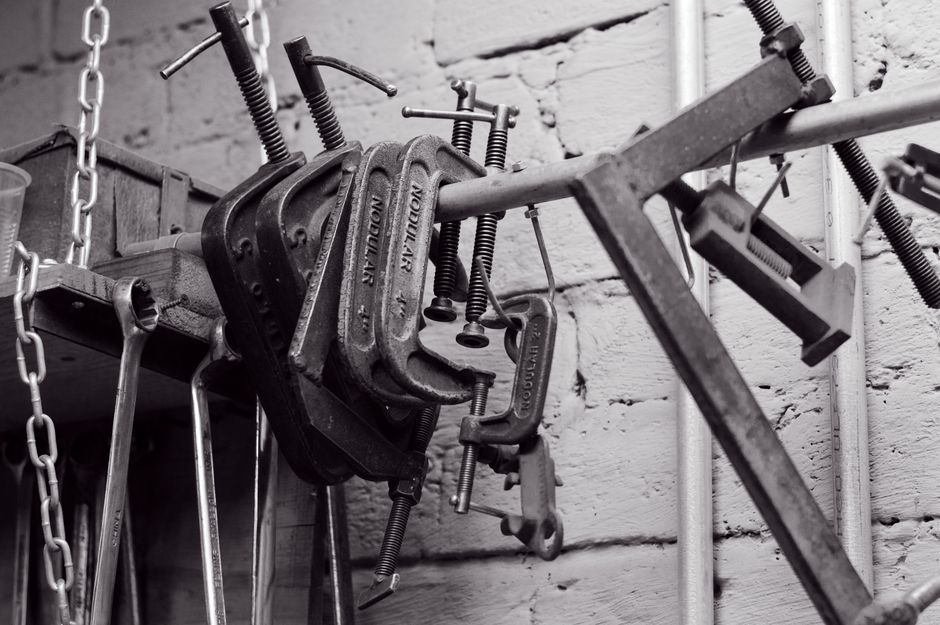
Old PONY and Jorgensen bar clamps surface constantly at estate sales, farm auctions, and online marketplaces, because they were built in huge numbers and very few of them have worn out. The play is simple: apply the failure rubric at the seller's table, discount for everything missing, and walk away from rails that do not pass.
- Rail flatness. Sight down the bar the way you would a board, then lay it on a known-flat surface such as a table saw top. A bowed or twisted rail is either a pass or a heavy haggle.
- Fixed head. Try to move it by hand, then with a mallet tap. Any creep means re-staking at best.
- Movable head. Snap the clutch forward and crank it. It should lock positively with no skipping.
- Screw. Run it through full travel. Binding from glue fossils cleans up; visible wobble means the screw or nut is worn, and matching replacements for vintage threads are a scavenger hunt.
- Pads. Expect them to be missing and price accordingly. Check that the mounting holes are intact.
Since used bar clamps vs new parallel clamps is a genuine fork, here are the honest trade-offs. You give up parallel geometry, so cauls and careful clamp placement do the alignment work with more setup. You give up jaw depth on tall panels and single-motion speed. You get lighter clamps that hang closer to the wall, trivially simple mechanisms, and a price per usable clamp that new manufacturing cannot approach. For mostly flat panel work, cauls close most of the gap. For casework with wide, tall surfaces, parallels earn their keep.
What to Buy for Your Shop
Match the purchase to the work:
- Panel-heavy cabinet work. Four to six Bessey K Body REVOlution clamps at deal pricing, in a 24/40/50 mix, plus a spare pad set in the same order. If you want the best clamps for panel glue ups and the budget allows, this is the set.
- Buy it for life on a budget. Used steel bar clamps for structure, pipe fixtures for odd lengths, and cauls for alignment. Add parallels opportunistically when the seasonal deals return.
- Occasional builder. Two decent parallels, Cabinet Master or Irwin on sale, plus pipe clamps for everything long.
Maintenance is what actually gets any of these to year twenty:
- Once a year, scrape dried glue off the screws, hit them with a brass brush, and re-coat with wax.
- Wax the rails too, so squeeze-out pops off instead of fossilizing.
- Tape or pad every glue surface; most clamp damage is glue, not load.
- Replace pads when chewed, not after they mark a finished panel.
Closing the loops from the top. Which clamp survives twenty years? Nearly any name-brand one, because the rail never retires the tool; what differs is the replacement list and how easily you can buy it. Is the Bessey deal worth pulling? If parallels are the goal, yes, at the reported $189.99, on the strength of the parts ecosystem. Does used steel beat a new deal? On cost per usable decade, the estate-sale bar clamp wins and charges you in geometry. The deal post is right that the sets sell out every year; grab one if you want it. Just be clear about what a twenty-year clamp purchase actually is: an effectively immortal rail wearing a decade or two of cheap, replaceable parts.
Stay in the loop.
Get the latest posts and exclusive content delivered to your inbox.
Join 54 readers. No spam. Unsubscribe in one click, anytime.
About the author
Naomi Estrada
Value and Comparisons Analyst
Naomi came to durable goods through cost-per-use economics, running the numbers on cheap-versus-quality for a personal-finance site before going all-in on BIFL. She builds the head-to-head comparisons and best-of rankings so readers stop guessing and buy the right product the first time.
Related Posts

Craftsman Tool Advent Calendar Graded for 20-Year Ownership
The $65 Craftsman tool advent calendar promises $200 in tools. We grade it in value-per-decade instead, from hex-key steel to V20 battery lock-in.

The Best Utility Knife Is Not the Week-One Winner
The best utility knife for a decade of work is not the week-one winner. We re-rank 9 tested knives by failing parts and 10-year blade cost.

The Best Tool Belt Is the One That Fails Last
The best tool belt is the one that fails last. We rank leather and nylon rigs by the parts that break first, with cost-per-year math by trade.