Best Carbon Steel Pan for Life, Ranked by Real Failure Modes
The best carbon steel pan is the one that never warps or sheds its handle. Gauge math and rivet checks show why 3mm restaurant pans outlast boutique ones.
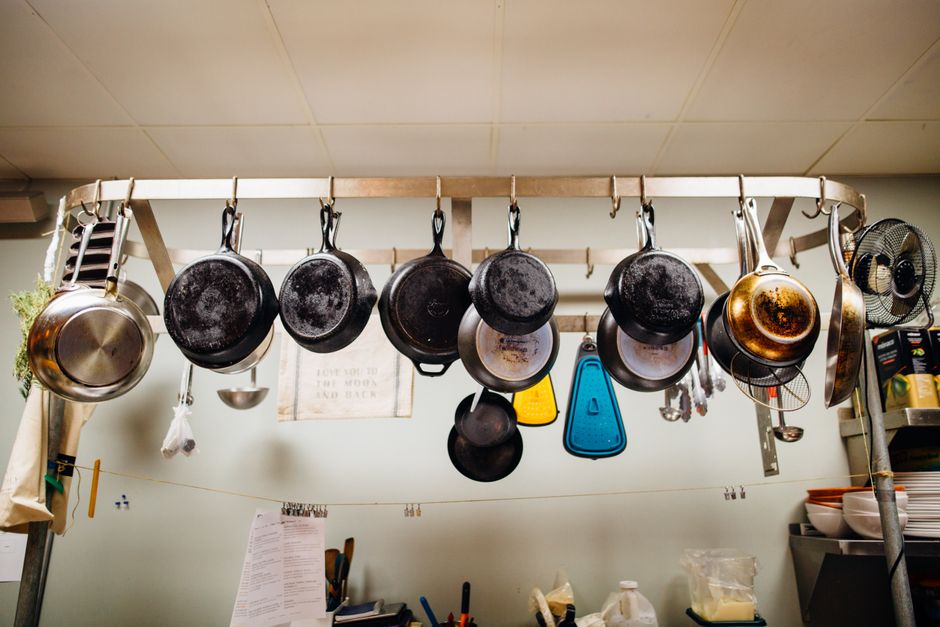
The best carbon steel pan is the one still flat and still attached to its handle in 2045, not the one with the silkiest egg slide in week one. A carbon steel body is simple rolled steel with a trace of carbon in it, and nothing about ordinary cooking consumes it. The seasoning on top is infinitely renewable, strip-and-rebuild, as often as you like. A pan's lifespan therefore comes down to structural failure, and there are only two that count: the metal going out of true, and the handle joint letting go. Read any product page through that lens and two specs start doing all the work, millimeter gauge and joint type. That is also why 2.5mm to 3mm restaurant stock from Vollrath, de Buyer, and Matfer routinely outlives boutique pans selling for triple.
Stay in the loop.
Get the latest posts and exclusive content delivered to your inbox.
Join 36 readers. No spam. Unsubscribe in one click, anytime.
The Two Failures That Kill a Carbon Steel Pan
How long does a carbon steel pan last? Most review content answers with the wrong variables: egg release, seasoning speed, wall color, handle comfort. Those describe a surface you can renew in an afternoon, and they say nothing about whether the pan survives its second decade.
Geometric failure is warping. A pan is a flat disc, and a disc flexes when one zone expands faster than another. Past a threshold it stays flexed. A warped pan rocks on the burner, spins on glass tops, and heats unevenly forever after. On induction it can even lose contact with the coil entirely.
Mechanical failure is joint failure. The handle attaches through rivets, welds, or screws, and that joint carries the full torque of a pan loaded with food. Rivets loosen. Welds crack. A pan that sheds its handle during an oven pull is finished.
Everything else is maintenance. Rust buffs off. Sticky seasoning strips and redoes. A discolored wall still sears. If you are shopping for a buy it for life cookware candidate, you are really shopping for flatness retention and joint integrity, and both are judgeable before you pay.
How Pan Gauge in Millimeters Predicts Warping
Carbon steel pan thickness is the one lifespan number you can check before buying. Manufacturers publish it in millimeters on spec sheets, and where a brand does not, a twenty-dollar pair of calipers settles it in seconds on any pan you can hold. Measure a clean spot on the wall, since built-up seasoning adds only a trivial fraction of a millimeter.
The mechanism is thermal shock. Steel expands as it heats. When one ring of the pan is hot while the rest stays cool, the hot zone grows against metal that refuses to move, and the pan relieves the stress by flexing. Rinsing a ripping-hot pan under a cold tap manufactures that gradient deliberately. Guides on how induction warps cookware and what makes pans warp resistant cover the same physics from the commercial side: gradient, not total temperature, is what bends metal.
That yields three practical tiers.
| Stock thickness | Behavior | Realistic use |
|---|---|---|
| Under 2mm | Flexes audibly, warps under thermal shock and aggressive induction | Crepes and omelets, gentle heat only |
| Around 2.5mm | Resists normal kitchen abuse, still needs basic care | The floor for a do-everything pan |
| 3mm | Holds flat through hard use; heavier and slower to heat | Decade-scale daily cooking |
What thickness carbon steel pan is best follows directly: 2.5mm is the minimum for a keeper, 3mm is the target.
Induction gets its own warning. Does a carbon steel pan warp on induction? It can, more easily than on gas, because a coil heats a ring rather than the whole base, creating steeper, more concentrated thermal gradients than flame or radiant electric, with high-power hobs exaggerating the effect on thin stock. It is no accident that de Buyer sells an induction-specific line, de Buyer's Prima Matera, built around a base engineered to spread coil energy. Carbon steel pan warping complaints cluster around thin pans on big burners.
Handle Joints, the Failure Nobody Tests

No mainstream review puts a torque gauge on a handle, which is strange, because joints retire more pans than cooking ever does. Carbon steel pan handle rivets versus welds is really a question about failure paths.
Riveted joints are the restaurant standard. They survive decades of abuse and, critically, they fail gradually. A loose handle is annoying but repairable: re-peening the rivet heads or firmly re-clamping them usually restores a solid joint, and that kind of carbon steel pan loose handle fix costs an afternoon, not a replacement. Gradual, fixable failure is exactly what you want in a joint.
Rivetless welded joints give a smooth interior with no rivet domes to clean around. The trade-off is the failure mode. A weld tends to either hold or crack, and a cracked rivetless weld usually ends the pan, since re-welding a seasoned cookware wall rarely makes economic sense. If you buy welded, inspect the bead for gaps and porosity before you season.
Screwed joints appear on budget pans and removable-handle designs. Heat cycling loosens and eventually strips them, though they are the easiest to service. Acceptable as a budget path, weak as a forever path.
On a product page, look for the words riveted handle or count rivet domes in the photos. In a store, grab the handle and twist hard. Rotation or clicking on a new pan only gets worse.
The Best Carbon Steel Pan by Decade Survival
Judged on survival rather than on week one, the best carbon steel pan shortlist looks almost nothing like the boutique bestseller list. The Vollrath vs de Buyer vs Matfer carbon steel question resolves on price and size availability rather than on steel quality, because all three sell riveted pans in the right gauge band.
| Pan | Gauge | Joint | Verdict |
|---|---|---|---|
| de Buyer Carbone Plus | 2.5 to 3mm by size | Riveted | Best overall survivor |
| Matfer Bourgeat black steel | Around 2.5mm, listed by size | Riveted | Best French value |
| Vollrath fry pan | Published on its spec sheet | Riveted | Best U.S. supply value |
| de Buyer Mineral B | 2.5mm in most sizes | Riveted | Best mainstream pick |
| Lodge carbon steel skillet | Mid-band, listed on its page | Riveted | Best budget buy |
| Made In | Thick boutique stock | Riveted | Good pan, worse math |
The podium is boring on purpose. de Buyer Carbone Plus is the professional-kitchen blank, running 3mm in the sizes that run it, minus the beeswax finish of the retail line. The retail line's own de Buyer Mineral B specs confirm 2.5mm stock in most sizes, and it is far easier to find in stores. Both brands vary thickness by diameter, so buy the size, not just the model.
Matfer Bourgeat's listing shows the traditional riveted handle and the gauge for each diameter, so verify before you buy, same rule. Vollrath's spec sheet publishes gauge the way industrial buyers expect, and supply-house pricing usually lands well under boutique retail for equivalent steel, which is the price inversion in a single sentence. Lodge's carbon steel skillet is the honest budget option: widely stocked, riveted, no boutique premium.
Made In closes the list as the boutique contrast. By most accounts, including Prudent Reviews' measurements, it is a genuinely thick, well-made pan. It simply costs boutique money for restaurant-supply steel, and the difference buys design and marketing rather than millimeters.
Boutique Pan Myths That Cost You Money
Four beliefs reliably move money from buyers to marketers, and all four collapse on inspection.
Price buys durability. The assumption says a pan at triple the price outlasts a cheap one. Rolled steel is a commodity, and wall thickness does not scale with brand positioning. Boutique pricing buys design, packaging, and support, none of which thickens the metal. The evidence runs the other way: pans built for cooks who abuse equipment daily are thick and cheap.
Seasoning difficulty signals quality. Difficulty signals thin steel and rough mill scale, not excellence. A 3mm pan seasons more slowly because mass resists temperature swings, the same property that keeps it flat.
Warranty length equals lifespan. A forever warranty is a marketing document until you read the exclusions. Thermal-shock warping and gradual handle wear are precisely the failures terms tend to carve out. Read Made In's warranty terms as a worked example of the genre before any brand's longevity language moves you.
Reviews rank longevity. Even excellent roundups, including Serious Eats' carbon steel testing, score what a tester can evaluate in weeks: eggs, searing, weight, handle feel. Useful data for week one, silent on year ten, and that gap is the entire reason to rank by failure modes instead.
Care Habits That Prevent Both Failures
Why did my carbon steel pan warp is usually answerable from the ten minutes before the question was asked. Prevention is a short list.
- Preheat in stages. A minute or two on low before you turn up shrinks the base-to-edge gradient, the same gradient that bends metal.
- Never quench a hot pan. Cold tap water on hot steel is the classic warp recipe. Let the pan fall below sizzling on its own, then wash.
- Match pan to coil. On induction, a base barely larger than its coil concentrates energy into a hot ring. Center the pan, choose sensibly sized burners, and reserve boost modes for boiling water in other pots.
- Torque-test the handle twice a year. Twist hard. Movement caught early is a five-minute re-peen; ignored, it becomes play, then cracking around the joint.
- Re-season without sentiment. The surface is infinitely renewable, so strip and rebuild whenever performance slips. Routine renewal removes every reason to baby the pan except the two structural rules above.
The Buying Rule in Plain Numbers
Open any product page and make the call in under a minute.
- Gauge: 2.5mm minimum, 3mm ideal, and no purchase without a published or measured number.
- Joint: riveted preferred, welded only with an inspected bead, screwed only for budget pans.
- Induction: every carbon steel pan is magnetic, so fit is universal. The risk is thin stock on a big, powerful coil, and thickness is the insurance.
- Price: expect the value to sit in restaurant supply, not boutique retail.
Best value: Vollrath or Matfer Bourgeat at supply-house pricing. Best overall survivor: a 3mm size of the de Buyer Carbone Plus. The best carbon steel pan for life is a buy it for life carbon steel pan that costs less than the boutique option, precisely because nobody paid to advertise it to you.
Stay in the loop.
Get the latest posts and exclusive content delivered to your inbox.
Join 36 readers. No spam. Unsubscribe in one click, anytime.
About the author
Cal Whitmore
Durability Testing Lead
Cal has spent a decade in product testing, from tool labs to outdoor gear reviews, and treats every claim of a lifetime warranty as a hypothesis to break. He writes about the materials, joinery, and failure modes that actually decide whether gear lasts twenty years or two.
Related Posts
Buy It for Life Immersion Blenders Ranked by What Breaks
Buy it for life immersion blenders ranked by the parts that actually die: coupling, shaft bearings, seal, and switch, with the 1980s Braun as benchmark.
Buy It for Life Grain Mills Ranked by the Parts That Die
We rank buy it for life grain mills by the parts that die first, from crank bearings to sealed motors, with burr costs and 20-year survival scores.
Oil Sprayers Ranked by Why They Stop Misting
Oil sprayers die in the head, not the bottle. Our failure-mode ranking explains why misters stop spraying and which oil sprayer designs last for years.