Knife Handle Materials Ranked by Decade Survival
Knife handle materials ranked by decade survival: G-10 and micarta outlast carbon fiber on impact toughness, and rehandle cost settles the ranking.

Everything else on a good knife gets a second chance. A dull edge regrinds. A sloppy pivot tightens or takes new washers. Even lockbars get fresh inserts on the knives designed for it. The handle material is the one spec you choose exactly once, and on many constructions it can never be economically replaced at all. So the honest way to rank knife handle materials is by how they die, not by how they feel at a knife counter.
Stay in the loop.
Get the latest posts and exclusive content delivered to your inbox.
Join 41 readers. No spam. Unsubscribe in one click, anytime.
Ranked that way, the price ladder flips. G-10 and canvas micarta, the two workhorse composites, shrug off the point impacts and fuel spills that crack carbon fiber scales. Titanium and aluminum trade cracking for denting, finish wear, and corrosion around fasteners. The premium badge and the decade-survival ranking point in opposite directions, and fixing a wrong choice usually costs more than the price gap you were agonizing over in the first place.
Why the Handle Is the Real Buy It for Life Decision
We have argued before that the blade steel is the least of your problems, because steel is renewable in a way no other component is. Locks and pivots retire folders eventually, but they are serviceable by design. The scales are different. If you want a buy it for life pocket knife, handle material is the spec that decides whether the knife actually reaches that goal.
Two constructions make the choice effectively permanent:
- Integral handles, machined from a single block of metal with no separate scale to unscrew. What you buy is what you own until the knife is scrapped.
- Pinned or riveted scales, common on traditional folders and many fixed blades. Replacing them means drilling out pins, sourcing or machining new scales, and re-peening hardware. Most owners never will.
Even screwed scales only stay serviceable while someone makes replacements. Popular models have that ecosystem. Obscure ones do not, and a fifteen-year-old knife with a cracked scale and no parts supply is a shelf queen, not a tool.
The Five Failure Modes That Retire Handles
Premium marketing ranks materials by feel, weight, and finish. A decade of ownership grades them on five failure modes instead. This is the rubric the rest of the article uses.
- Point impact. The tip drops onto rock, a batoning strike misses the spine, a pry attempt twists. Point loads concentrate at scale edges and screw bosses, the thinniest, most stressed geometry on any handle.
- Drop shock. An open knife hitting concrete corner-first transmits a sharp impulse through thin scales. Dumbbell-shaped damage, but it is the single most common way handles actually get hurt.
- Chemical exposure. Gun solvent, brake cleaner, gasoline, DEET, acetone from a shop rag. Some plastics craze or soften on contact; industrial laminate makers publish chemical resistance charts showing glass-epoxy and phenolic laminates holding up against fuels, oils, and common solvents, which is exactly the exposure a working knife sees.
- UV, thermal cycling, and moisture. Dash heat in summer, a freezing truck in winter, sweat and rain in between. Repeated expansion and contraction works on fastener beds; UV slowly chews clearcoated epoxy.
- Fastener bedding and corrosion. Every screw hole is a stress concentrator. Dissimilar metals in wet conditions set up galvanic pairs, and galled threads turn routine maintenance into a stripped disaster.
Grip retention when wet matters for usability, but it does not kill handles. The five modes above do.
How the Five Knife Handle Materials Rank
For decade survival under hard use, the most durable knife handle material is a tie at the top: G-10 and canvas micarta first, titanium second, aluminum third, and carbon fiber last, despite carbon fiber's premium pricing. Here is the full picture.
| Material | Impact toughness | Aging over a decade | Wet grip | Service path |
|---|---|---|---|---|
| G-10 | Excellent, scuffs instead of cracking | Texture glosses at contact points, stays dimensionally stable | Very good | Screws off; aftermarket scales common on popular models |
| Canvas micarta | Excellent, dents slightly at edges | Darkens with oil and sweat, edges round gently, structure stays sound | Excellent | Re-pinnable or re-scaleable at modest cost |
| Titanium | Good, dents rather than cracks | Scratched finish, worn anodizing, possible thread galling | Slick | Parts-dependent, factory service realistic |
| Aluminum | Fair, dents readily | Anodizing wears through at edges, galvanic pitting around screws | Slick | Rarely worth re-scaling |
| Carbon fiber | Poor under point loads | White stress lines, clearcoat UV wear, cracks at screw bosses | Fair | Effectively none on most models |
Both top materials pair a tough fiber reinforcement with a resin matrix, and that combination is why hard-use makers default to them. Glass fabric gives G-10 its stiffness and cut resistance, documented in any G-10 FR-4 data sheet, while cotton canvas in phenolic resin gives micarta its slightly more dampened, hand-friendly character, per the canvas phenolic data sheet. Together they hold the best combined score across impact tolerance, chemical and fuel resistance, and hidden wear of any materials in this comparison.
G-10 vs Micarta: Which Is Tougher?
Close enough that the answer is "whichever your favorite maker uses." G-10 runs a touch harder and glassier, with arguably the best chemical resistance of the group. Canvas micarta is marginally better in the hand when soaked and takes on a patina instead of looking worn. Neither one loses a fight with a decade. Choose between them on texture and looks, because toughness is a wash.
The Carbon Fiber Problem
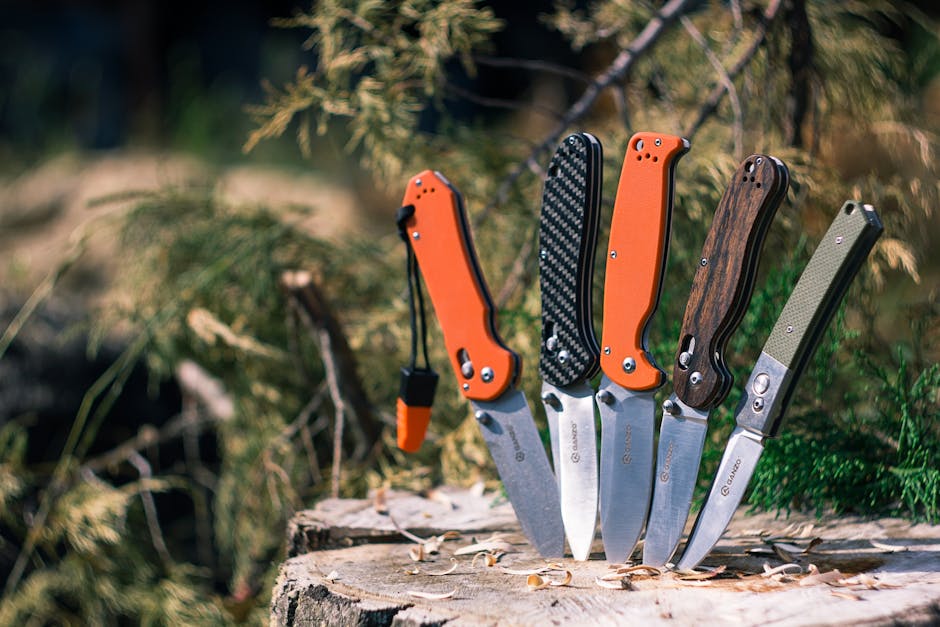
Do carbon fiber knife scales crack? Yes, and the mechanism is well understood. Carbon laminates carry loads efficiently along their fibers, which is why the material dominates aerospace structures loaded in predictable directions. But the epoxy matrix has a low strain-to-failure, and loads applied out-of-plane, straight into the face of the laminate, are the worst case. Low-velocity impact research on composite laminates documents the result: matrix cracking and internal delamination from impacts that leave no visible mark on tougher materials, damage that then grows under load.
For a knife, read "out-of-plane point load" as dropping an open knife onto gravel, or clipping a scale edge on concrete. The same hit that leaves a white scuff on G-10 or a small dent in titanium can start a crack in carbon fiber scales, typically radiating from a screw boss. And the premium upcharge buys nothing here. Everyday Commentary's carbon fiber writeup tallied the densities and found canvas micarta starting around 1.35 g/cm³ against carbon fiber's 1.4 to 1.9, meaning the fancy option is often the heavier one, while concluding that its structural advantages simply do not matter at knife-scale thicknesses. The cachet is marketing carried over from applications where the material genuinely is revolutionary.
Fairness requires two caveats. Carbon fiber's chemical resistance is fine, and its stiffness-to-weight is real. On a dress knife that will never be dropped on rock, it stays a defensible choice. The problem is paying a premium for the least impact-tolerant material on a knife you intend to actually use for decades.
How Titanium and Aluminum Age
Metal scales do not age better than composites. They age differently, and the differences are where the money hides.
Titanium scales
Titanium knife scales, typically Ti-6Al-4V per the standard Ti-6Al-4V data sheet, essentially never crack from drops. That is a genuine virtue, and it earns titanium second place. What you get instead:
- Dents at corners and edges that cannot be buffed out of a structural part.
- Heat transfer. Titanium grabs cold in winter and holds dash-top heat in summer harder than any composite will.
- Cosmetic finish wear. Anodized color and stonewash both scratch to bare metal, purely a looks problem but permanent.
- Galling. Titanium on titanium threads, including pivot hardware, can cold-weld under load and seize. The standard titanium galling prevention playbook is lubrication and sane torque, which is to say, maintenance you must actually do.
Aluminum handles
Aluminum knife handles, typically 6061-T6, are the budget metal, and the savings show up as failures. The alloy is softer, so pocket keys and a single drop to pavement leave dents. Hard anodizing wears through at edges and high spots, and then the metal is exposed.
The nastier issue is electrochemical. Aluminum sits anodic to the stainless fasteners that hold most knives together, so in wet or salty conditions the aluminum corrodes preferentially around every screw. The corrosion products swell, the screws seize, and what should be a five-minute scale swap becomes a drilled-out horror show. Rinse and dry an aluminum knife after saltwater exposure and the problem mostly stays theoretical. Ignore it and the fastener beds are where the handle dies.
What a Rehandle Actually Costs
This is where the ranking turns into money. Fixed blade knife rehandle cost by a custom maker typically runs on the order of a hundred dollars or more, plus shipping both ways, plus whatever the waitlist is. Against a material upcharge of often $40 to $100 at retail, the math is brutal: the recovery path for a bad scale choice frequently costs more than the price gap you were deciding between.
Folder scale replacement is model-dependent, and the spread is enormous. For popular platforms there is a healthy aftermarket, with retailers stocking aftermarket scale listings and upgrade hardware for the big names. For everything else you are into one-off CNC work at custom-maker prices, if the CAD files even exist. And for integral or channel-construction handles, including many autos, replacement is effectively off the table; factory service is the only realistic path, and only while the factory feels like it.
The buying rule that falls out of this: on a knife you intend to keep, never pay a premium for the least durable option. The cheap fix does not exist.
Five Knives, One per Material
Abstractions get old fast, so here is the ranking wearing serial numbers. These are also the aging signals to inspect before buying any of these used.
| Knife | Material | What a decade does | Inspect for |
|---|---|---|---|
| Spyderco Paramilitary 2 | G-10 | Glossing at high spots, minor chips at screw bosses | Delamination at pins, stripped hardware |
| ESEE-4 | Canvas micarta | Darkens with sweat and oil, edges round into a grip-shaped patina | Loose pins, cracking around the lanyard hole |
| Chris Reeve Sebenza | Titanium | Scratches and worn finish, possible pivot galling | Seized pivot screw, wallowed threads |
| Microtech LUDT | Aluminum | Dented corners, worn anodizing, halos of corrosion at screws | Seized Torx fasteners, pitting under the scale |
| Benchmade 940-1 | Carbon fiber | White stress lines, scuffed clearcoat | Hairline cracks radiating from screw bosses |
On the micarta question people always ask, how long do micarta knife handles last: canvas-phenolic handles from mid-century working knives are still in service, and an ESEE-4's scales will almost certainly outlive several owners' interest in it. The aging you see is cosmetic. The same cannot be said two rows down the table.
Choosing Your Handle Material by Use Case
The best handle material for a hard use knife depends on which failure modes you will actually inflict.
| Use case | Pick | Why |
|---|---|---|
| Hard-use outdoors | Canvas micarta or G-10 | Point impacts, fuel, wet grip, freezing mornings, all covered |
| Work EDC | G-10 | Solvent-proof, texture survives gloves and pockets, cheap to rescale on popular models |
| Dress carry | Carbon fiber or titanium fine | Impacts are rare, weight and looks carry real value, and the ranking's weak spot never gets tested |
A five-point checklist before you click buy:
- Construction. Screwed scales, or integral/pinned? Only the first is recoverable.
- Parts ecosystem. Does an aftermarket exist for this exact model, or is it a one-season run?
- Fastener metals. Stainless screws in aluminum scales plus saltwater equals seized hardware.
- Your real chemical exposure. Shop solvents and fuel rule out anything that crazes.
- Honest impact odds. Rocks and concrete in your future means the composite column of the table, full stop.
The material that wins decade survival costs less than the one that loses it. That inversion is the whole decision, and now you know which side of it to buy on.
Stay in the loop.
Get the latest posts and exclusive content delivered to your inbox.
Join 41 readers. No spam. Unsubscribe in one click, anytime.
About the author
Reggie Calloway
Heritage and Craft Editor
Reggie writes about the makers behind lifetime gear, from third-generation tanneries to family-owned foundries. A former magazine editor, he profiles the brands, materials, and craftsmanship that justify keeping a tool or a jacket for the next generation.
Related Posts
Buy It for Life Scissors Ranked by Pivot and Steel
Buy it for life scissors ranked by pivot serviceability and sharpenability, plus why induction-hardened edges can turn tough shears into consumables.

The Best Utility Knife Is Not the Week-One Winner
The best utility knife for a decade of work is not the week-one winner. We re-rank 9 tested knives by failing parts and 10-year blade cost.

The Best Tool Belt Is the One That Fails Last
The best tool belt is the one that fails last. We rank leather and nylon rigs by the parts that break first, with cost-per-year math by trade.