The Most Durable Burr Coffee Grinder Is the One You Can Fix
The most durable burr coffee grinder is the one you can fix. Oxo Brew versus Baratza, ranked by the parts that die first, plus the decade repair math.

Burr grinders rarely retire because the coffee got worse. They retire because a plastic reduction gear stripped, a motor bushing wore oval, or a control board quit, and nobody sells the replacement. The most durable burr coffee grinder for a decade of daily use is the one whose maker still sells the part that breaks in year six, and no week-one review can tell you that. Consistency charts measured on fresh machines say nothing about year five, because the parts that fail first, the drivetrain, the bushings, and the electronics, arrive healthy and die slowly.
Stay in the loop.
Get the latest posts and exclusive content delivered to your inbox.
Join 36 readers. No spam. Unsubscribe in one click, anytime.
This guide ranks the category the way a repair bench would, by failure mode and by the parts counter. The short version is uncomfortable for the premium end of the market. Baratza's sell-every-part model makes its mid-range machines the cheapest electrics to own for ten years. Oxo's warranty-first approach protects the early years and strands the late ones. Sealed premium grinders hide board failures that can total the unit. And a quality hand grinder, with no motor to kill, is the longevity pick for moderate volumes.
What Retires a Burr Grinder First
Which burr grinder parts break first decides a machine's fate far more than which burrs it ships with, and whether you can buy those parts decides everything after that. The ordering below is consistent across the category, and it is almost the reverse of what marketing emphasizes.
| Component | How it dies | Rough window | Sold separately? |
|---|---|---|---|
| Drive gear and mounting collar | Stripped plastic teeth or a cracked collar, often after a stall | Years 2 to 6 | Baratza yes, most sealed brands no |
| Motor bushings | Wear from dust and dried coffee oils, then shaft play | Years 4 to 8 | Rarely, at any price tier |
| Switches and wiring | Contact fatigue and spills | Unpredictable | Baratza yes, patchwork elsewhere |
| Control and dosing boards | Electronic failure with no warning | Any time | Almost never |
| Burrs | Edge rounding after extreme volumes | Usually year 10 and beyond | Commonly, from most makers |
Treat the windows as rough ordering drawn from owner reports and repair techs rather than lab data. The ranking is the reliable part.
Then do the home math on the burrs everyone markets. An 18 g daily dose runs roughly 6.5 kg of beans a year, about 65 kg over a decade, and makers commonly rate hardened steel burrs to stay usefully sharp for hundreds of kilograms. At household volumes the burrs are effectively immortal, and everything bolted around them is on a clock. The lifespan of a coffee grinder gets decided at the parts counter, not in the burr chamber, which means the most durable burr coffee grinder is chosen before coffee ever touches its burrs.
How Drive Trains and Motor Bushings Die
The plastic reduction gear, a fuse by design
Affordable burr grinders pair a small, fast DC motor with a gear reduction that slows it to burr speed, and that reduction is plastic in nearly every machine under a few hundred dollars. Partly that is cost cutting. Partly it is deliberate, because the burr grinder drive gear is the sacrificial part when something jams the burrs, whether a stone, a damp clump, or a cleaning pellet fed by mistake. The cheap gear strips before the stall cooks the motor. In a sane service ecosystem, that gear is a fuse. The part that ends a machine's life often sells for under $15 when it is sold at all, and mostly it is not sold.
Sleeve bushings versus ball bearings
On the motor side, budget grinders spin the shaft in sleeve bushings rather than ball bearings. Bushings are quiet and cheap, but they wear every hour the motor runs, and a grinder is an abrasive place. Fines drift down the shaft and mix with coffee oils into something close to lapping compound. The bushing goes oval, the shaft develops play, and the damage announces itself slowly.
Symptoms you can catch early
- The same setting lands coarser or less even than it used to, because shaft play lets the burr carrier wobble.
- Slow or reluctant starts, which point to bushing drag or a tired motor.
- A new dry whine or a change in pitch under load, which is gear teeth meshing differently as they wear.
- Visible wobble at the upper burr when you turn the shaft by hand with the hopper off.
None of these mean the machine is dead. They mean the countdown has started, and whether you can order the dying part determines how the countdown ends.
Oxo Brew, a Good Warranty With No Parts Counter
Oxo built its coffee line on kitchen-goods design sense, and the coverage that introduced it leaned the same way. Sprudge's interview with Oxo's Chris Diskin centered on design and how the tools feel in daily use, and that framing never has to answer how the tools come apart in year six.
In the early years, the Oxo model works well. The company documents a limited warranty for its conical burr grinder in the Oxo Brew grinder booklet, and owner reports have generally described responsive service, typically a replacement unit rather than a repair. A grinder that dies in year one or two is an inconvenience, not a loss.
The model inverts once coverage lapses. At the time of writing, Oxo does not operate a consumer parts catalog for its grinders comparable to what repair-oriented brands run, with no published exploded diagrams and no drive gears or bushings on a shelf. Coffee grinder makers sell replacement motor parts unevenly at best, and Oxo sells none. Oxo Brew grinder problems after a few years tend to follow a script. The motor slows, the burr carrier wobbles, and then the gear lets go. After that, the warranty clock rather than a parts order decides the outcome. An out-of-warranty Oxo has two destinations, a third-party shop willing to improvise or the recycling bin.
The usual Baratza vs Oxo coffee grinder comparison argues grind quality and price. Run it on decade durability and one brand treats failure as a parts sale while the other treats it as a warranty event, and only one of those transactions still exists in year seven.
Baratza Sells the Part That Dies

Baratza is the category's exception, and the exception is literal. The company publishes parts diagrams for its grinders and sells coffee grinder replacement parts directly to owners through the Baratza parts store, from drive gears and burr sets to switches, gaskets, and boards. Owners who would rather not turn a screwdriver can work through Baratza's product support hub, which walks through troubleshooting and runs a repair service, so DIY is an option rather than a requirement.
The money is almost embarrassing. A drive gear for an Encore-class machine has historically sold for well under $15, and a replacement conical burr set costs a fraction of a new grinder. Anyone comparing the cost of a Baratza Encore drive gear replacement against the price of a whole new machine is about to feel very good about the machine they already own, because the repair is a short screwdriver job. That accessibility is a large part of why decade-old Baratzas are common sights in kitchens and cafés.
The obvious risk with a model like this is corporate change, and Baratza had one, when Breville Group completed its acquisition of Baratza in 2020. The parts counter survived it. The parts store and diagrams remain available at the time of writing, which is the strongest available signal that this support is policy rather than accident.
That policy is why the brand tops any burr grinder repairability ranking. A mid-range Baratza plus perhaps $50 to $60 of parts spread over ten years is a cheaper machine than almost anything sealed, and its worst-case failure is a mail-order wait rather than a shopping trip.
Sealed Premium Grinders and the Sensor Board Gamble
Modern single-dose electrics such as the Fellow Ode and the Niche Zero added a failure surface their mechanical ancestors never had, electronics. Timed dosing, motor controllers, and grind-by-weight circuitry on some models all sit between the switch and the burrs, and each board is a component with a service life and a supply chain. A sensor board failure in a single dose grinder behaves differently from every mechanical failure above. There is no wear curve and no warning, and the machine works on Tuesday and is a paperweight on Wednesday.
To their credit, makers at this tier do sell replacement burrs, which addresses the one component that almost never dies at home volumes. Board-level support is where the catalog thins out. If a controller fails outside warranty and the maker does not sell that board, the machine is totaled regardless of price, and a $300 to $700 purchase becomes a very heavy burr holder.
Sealed premium grinders can run flawlessly for many years, and plenty do. The criticism is not reliability but forgiveness, because the failure mode most likely to total these machines is precisely the one nobody stocks.
Hand Grinders, Nothing Left to Burn Out
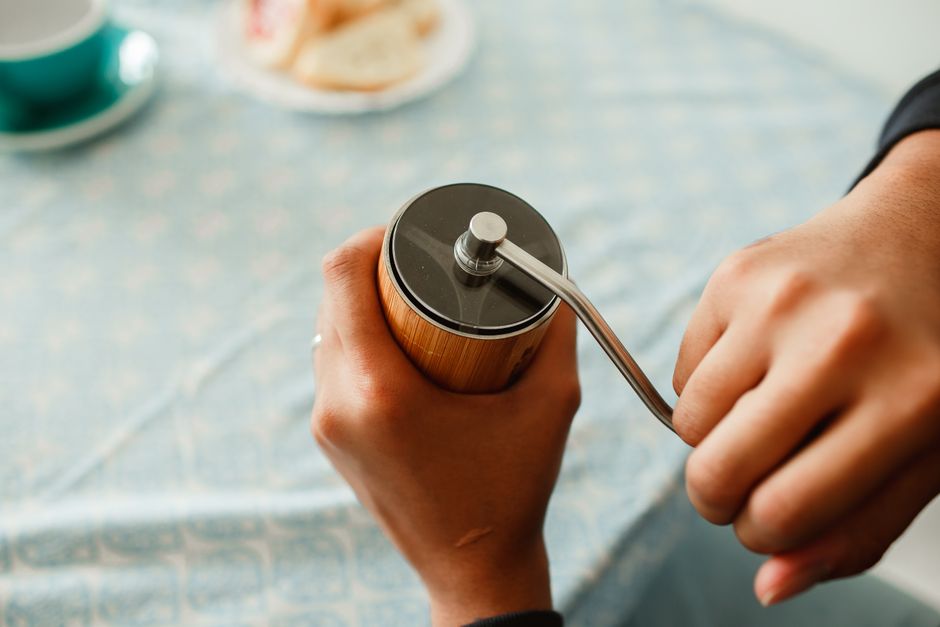
Delete the motor and you delete the failure list. A hand grinder has no motor to burn out, no bushings wearing oval, no reduction gear to strip, and no boards at all, which shrinks the wear surface to a drive shaft on bearings and a burr set. Both are cheap insurance, and both are stocked: 1Zpresso's spare-parts page for the JX-Pro sells exactly what wears, bearings and burrs included, and Comandante replacement parts are a normal retail item rather than a favor. The best hand grinder for longevity is any well-built one from a maker that sells bearings, which describes most of the reputable names.
The hand grinder vs electric grinder trade is effort, not durability. A coarse pour-over dose cranks in seconds; an 18 g dose taken to espresso fineness commonly takes a minute or more of steady cranking. The break-even is one or two cups a day, not four, and past that the silence and portability stop feeling like compensation. Match the tool to your real volume, not to your ambition.
The Ten Year Math Across Three Ownership Paths
Cost scenarios need their assumptions stated, so here are mine. A sealed entry-level grinder at $100, a parts-supported mid-range electric at $150, and a quality hand grinder at $170, with parts at $15 for a drive gear and $40 for a burr set. Every number is a placeholder. Swap in your local prices and the structure holds.
| Path | Year 0 | Repairs and replacements | Ten year total |
|---|---|---|---|
| Sealed entry grinder | $100 | Replace around years 4 and 8, $100 each | $300, plus two dead machines |
| Parts-supported mid-range electric | $150 | Drive gear in year 4 ($15), burr set in year 7 ($40) | $205, same machine throughout |
| Quality hand grinder | $170 | Possibly a bearing kit, under $20 | Under $190 |
Two things fall out of the table. First, a coffee grinder's ten year cost of ownership can run two to three times the sticker price on the sealed path, which makes sticker price a poor predictor of decade cost. Second, even where the totals converge, the paths are not equal. The parts-supported machine never goes down for longer than a mail-order wait, grinds like new after its burr swap, and stays out of the waste stream. The sealed path spends the same money and still eats the downtime, the setup, and two extra machines' worth of e-waste.
One honest caveat cuts the other way. If a sealed grinder survives the decade on its first motor, it wins outright. The table prices the risk rather than a certainty, and the whole argument of this piece is that the risk is the part you can actually check before buying.
How to Buy the Most Durable Burr Coffee Grinder
Before paying for any grinder, name the part most likely to fail on it, then check whether the maker sells that part. Five minutes of checking decides the next ten years.
Burr grinder repairability is the spec that quietly decides everything above, so the buying rules follow from it.
Rules by use case
- Daily drip or pour-over, decade horizon. Buy the parts-supported mid-range electric. Encore-class machines are the reference point because the worst-case failure is a parts order.
- Happy Oxo owner, still in warranty. Keep it and use the warranty without hesitation when something goes wrong. Then plan the exit around year three or four, while the machine still works and the decision is yours rather than forced.
- Espresso and single dosing. Weigh the board risk honestly. Mechanical simplicity is a durability feature at this tier too, and any machine with timed or weighed dosing carries a failure no cleaning prevents.
- Moderate volume, travel, or maximum longevity. A quality hand grinder from a maker that sells bearings and burrs is the only category where the most durable choice is also among the cheapest.
Maintenance that measurably adds years
- Clean the burr chamber and chute every two to four weeks at daily use. Fines mixed with coffee oils form the lapping compound that ovals bushings and wears gear teeth, and wiping it out slows exactly that wear.
- Inspect the burrs while you clean. A chipped edge or a visible groove means it is time to price a burr set, not a whole machine.
- Pick over your beans. One pebble stalls the burrs, and the stall spends itself stripping the sacrificial plastic gear.
- Check shaft play and upper-burr wobble twice a year. With the hopper off, turn the shaft by hand; growing play is the early warning that a bushing is going oval.
- On a hand grinder, check the bearings and burrs yearly. They are the entire wear surface and the cheap insurance stocked on parts pages, so a rough spin is an order, not a retirement.
- What not to do. Skip the rice. Hard grains hit the burrs at full torque and some makers advise against it outright, so use cleaning pellets or a brush instead. Do not wash burrs that are not designed to be removed, and dry any steel part you do wash, because rust is a self-inflicted failure mode.
Every open question from the top of this piece closes in the same place. Your grinder will almost certainly die of an inexpensive part that may or may not exist on a shelf, not of worn burrs or mediocre coffee, and the most durable burr coffee grinder is simply the one where it does.
Stay in the loop.
Get the latest posts and exclusive content delivered to your inbox.
Join 36 readers. No spam. Unsubscribe in one click, anytime.
About the author
Priya Raman
Repair and Restoration Writer
Priya maintains and restores everything she owns, from cast iron to mechanical watches, and has spent years in the right-to-repair community. She writes about maintenance, warranties, and repairs, the half of buy-it-for-life that keeps good gear out of landfills.
Related Posts
Buy It for Life Immersion Blenders Ranked by What Breaks
Buy it for life immersion blenders ranked by the parts that actually die: coupling, shaft bearings, seal, and switch, with the 1980s Braun as benchmark.
Buy It for Life Grain Mills Ranked by the Parts That Die
We rank buy it for life grain mills by the parts that die first, from crank bearings to sealed motors, with burr costs and 20-year survival scores.

Super-Automatic Espresso Machine Longevity Splits in Two
Super-automatic espresso machine longevity splits into cartridge-service and sealed designs. Compare both against a Gaggia Classic plus Baratza stack.